
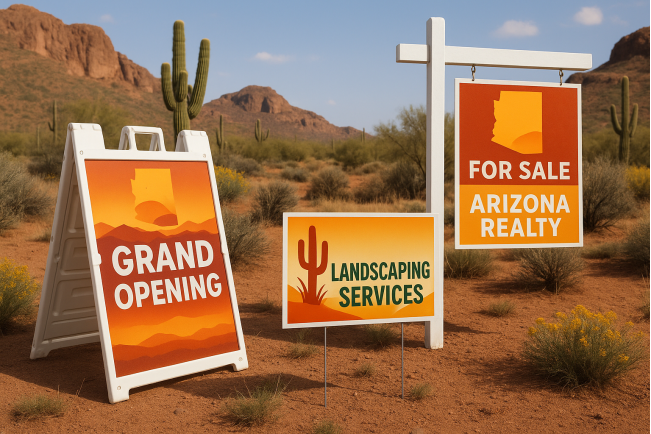
A sign has a practical job: help someone recognize, find or act on a message. Material and finishing choices should follow that job. A temporary indoor event panel does not need the same construction as an outdoor property sign exposed to wind and Phoenix sun.
Begin with viewing distance.
Information must be larger and simpler as distance and driving speed increase. Prioritize the business name, short message and next action. Fine-print service lists usually weaken the sign rather than add value.
Match the substrate to the use.
- Corrugated plastic:lightweight and economical for temporary yard signs and directions.
- PVC and display board:useful for indoor or protected rigid displays, depending on thickness and mounting.
- Aluminum composite:a stronger rigid option for many exterior panel applications.
- Banner:flexible, portable and efficient when the mounting points and wind are handled correctly.
Plan mounting before printing.
Holes, stakes, frames, standoffs and hanging points affect safe margins and layout. A panel designed without considering its frame may hide important information or fail to fit.
Account for Arizona exposure.
UV, heat, dust and irrigation can age a sign. Ask whether the project is for a weekend, a season or several years. That expected life helps determine print, laminate and substrate choices without overspending on a temporary use.